|
|
How Do We Make
Taxes More Fair?
And Solve The State
& Local Budget Crises.
The top 1% pays a smaller share of their income in state and local taxes than the rest of us.
|
|
|
Dear,
As I emerge from the labyrinth of filing taxes this year, this post-tax day I want to discuss with you two questions that I’ve been mulling over:
- Are taxes in Massachusetts fair?
- How do we navigate our state through the budget crises caused by the Trump administration’s cuts and attacks to civic society?
The good news is the voters of Massachusetts, including so many organizers in our district, worked hard to win the Fair Share Amendment, aka. the millionaire’s tax. That, and the 2023 tax cut package, have still left our state and local tax system upside down.
I want to break down what the numbers actually show, how we compare to other states and countries, and why this matters for everyone in our district.
The bottom line: our system is still upside down
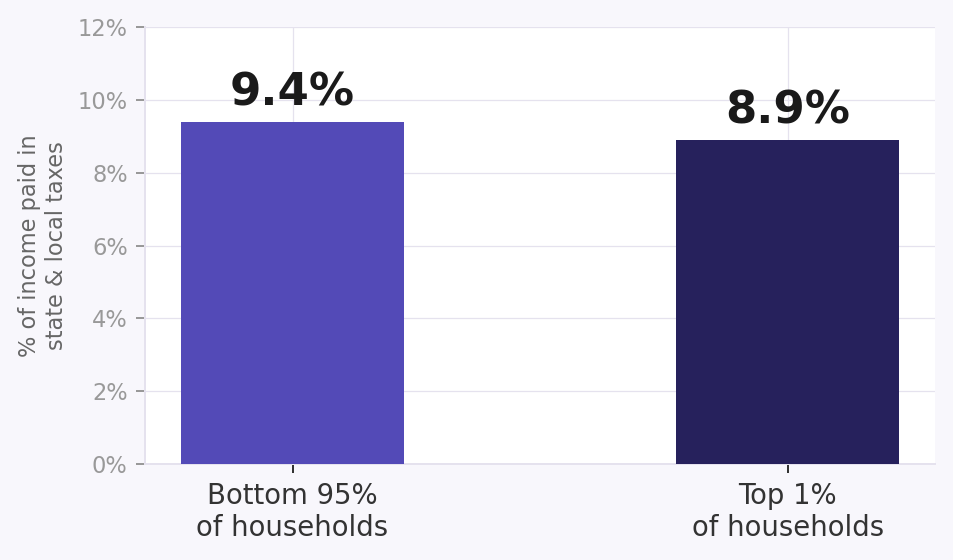
According to the most recent 50-state tax analysis, the top 1% of Massachusetts households, those earning roughly over $1 million a year, pay 8.9% of their income in state and local taxes. The other 95% of us? We pay 9.4%.
The wealthiest among us contribute a smaller share of their income than everyone else. This is called a regressive tax system, rather than a progressive one.
|
|
|
Source: MassBudget analysis of ITEP Who Pays? 7th Edition (Jan 2024).
Why? A family getting by on $40,000 spends almost all of it, and pays sales tax on their consumption that makes up a greater proportion of their income than a household earning $3 million. For the $3 million earning household a massive portion of their income is never touched by the sales tax at all.
How we got here and how the millionaire tax helped
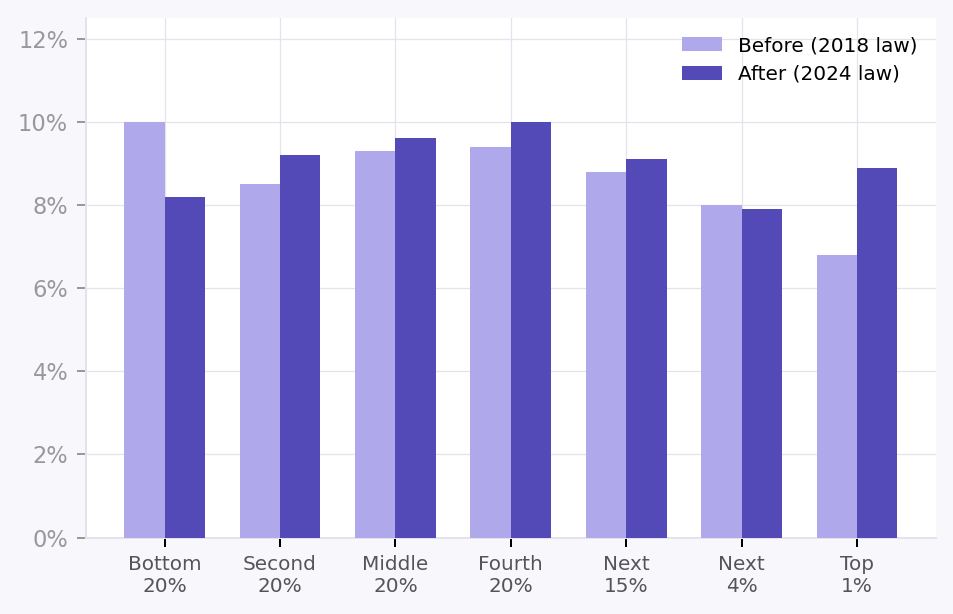
In 2018, before the Fair Share amendment, the least well to do paid an even higher share while the most well to do paid a smaller share. The bottom 20% paid 10.0% of their income in state and local taxes. The top 1% paid just 6.8%. That is a difference between the two was more than 3 percentage points in the wrong direction.
Voters changed that in November 2022 by approving the Fair Share Amendment: for every dollar earned over $1 million, residents pay an additional surtax of 4 cents. Combined with the 2023 tax package’s expanded credits for low- and middle-income households, the bottom 20%’s rate dropped to 8.2% and the top 1%’s rate rose to 8.9%. Real progress!
|
|
|
Sources: MassBudget 2018; ITEP Who Pays? 7th Ed. (Jan 2024).
But the system is still upside down. What we must be working toward is a tax system in which people with more income pay a greater share of their income than those who are struggling to get by.
How does Massachusetts compare to other states?
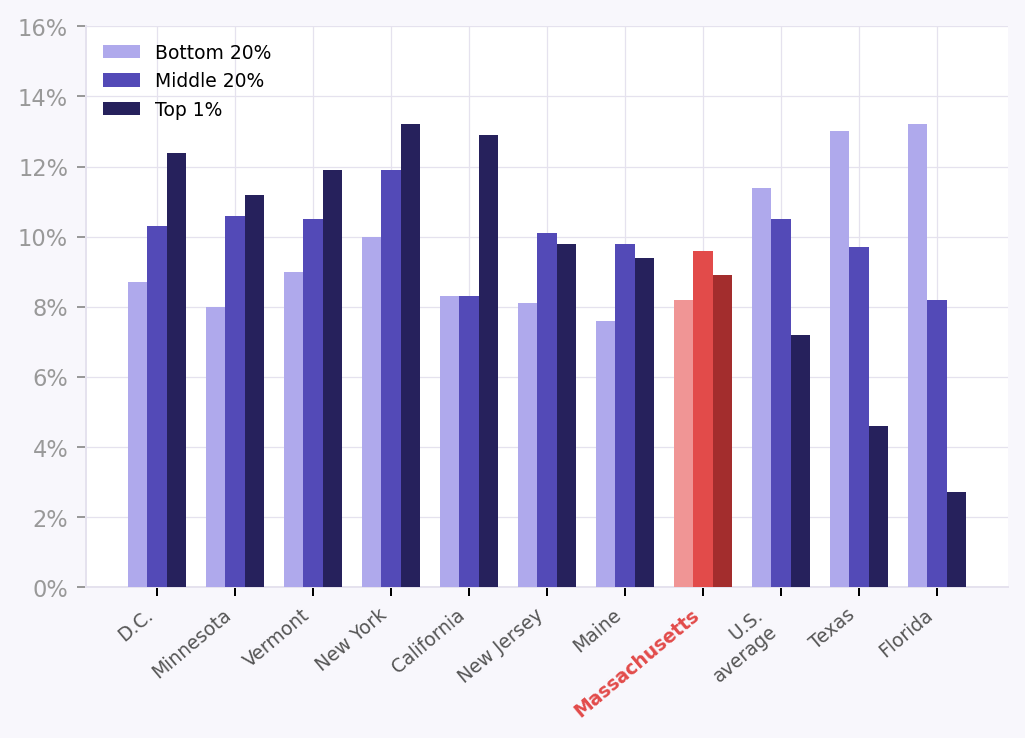
Seven states have already built what we have not: a tax system where the wealthiest pay a higher share of income than low- and middle-income families. Our neighbors Maine, Vermont, and New York are all on that list, along with California, Minnesota, and D.C.
And then look at states marketed as “low-tax” like Florida and Texas: in Florida, low-income families pay almost five times the rate of the wealthy. That is not low-tax, that is simply regressive and low tax for the wealthy.
|
|
|
Source: ITEP Who Pays? 7th Edition (Jan 2024).
The relative size of each bar for each state is what matters. In the right-side-up states, the dark bars (top 1%) are taller with higher earners pay a bigger share. In Florida and Texas, the dark bars are much lower. We are in the middle. Better than most, but not yet where we should be.
How do wealthy countries tax by income level?
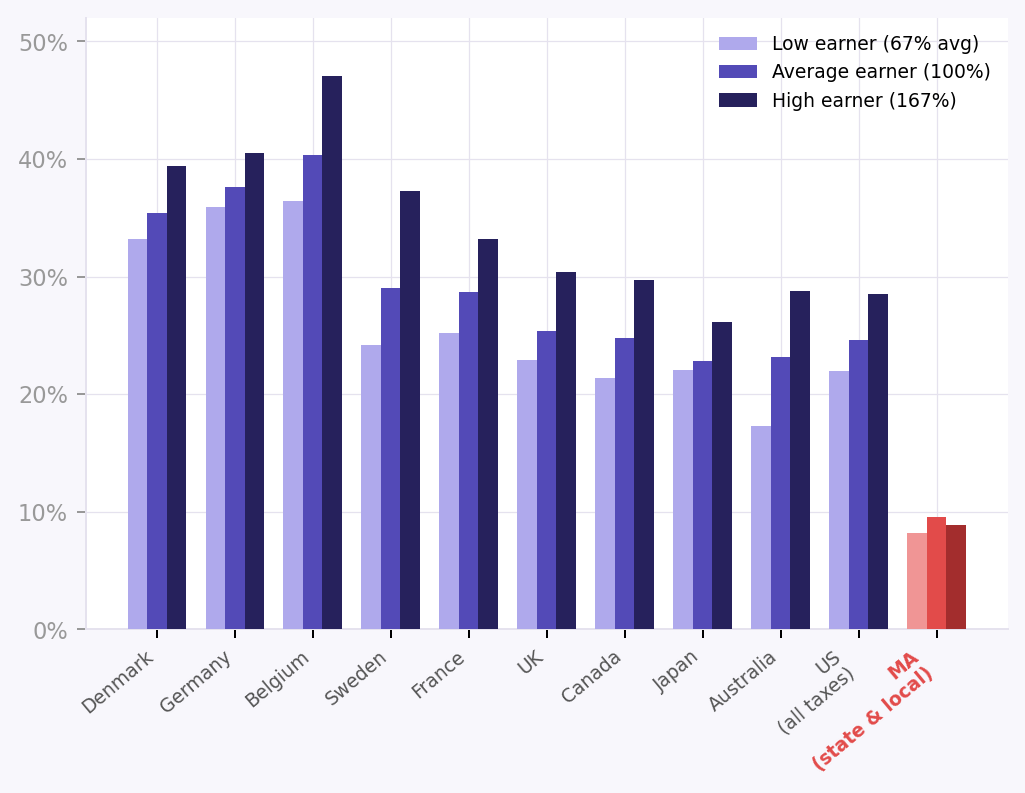
In virtually every wealthy democracy: Denmark, Germany, Sweden, the UK, Canada, Australia, the bars step upward as income increases. Higher earners pay a larger share. In Massachusetts, at the state and local level, the pattern reverses.
|
|
|
Sources: OECD Taxing Wages 2025; ITEP 7th Ed.
The OECD figures include national income tax and social insurance, so they are higher than our state-and-local-only numbers (this is not an apples to apples comparison). But the relative size of each bar for each country is what matters: in every wealthy democracy, the bars get taller as income rises. In Massachusetts, they do not.
Federal cuts are making things worse
Just as we began making our tax system fairer, federal policy moved in the opposite direction. The Big Ugly Bill that President Trump signed on July 4, 2025, is costing Massachusetts $664 million in lost state tax revenue this fiscal year alone, caused by changes to the federal corporate tax code that automatically flow through and reduce what our state collects unless the legislature decouples.
The House and Senate are now negotiating how to handle this. Governor Healey proposed delaying five of the costliest corporate tax provisions. The House went further, proposing to permanently decouple from those provisions if voters approve a ballot question to cut our income tax this November. I advocated for us to simply decouple from Trump’s Big Ugly Bill proposal to make our taxes more regressive, something other states have done.
But the tax revenue loss is just one piece. The bill delivers an estimated average federal tax cut of $84,800 to the top 1% of Massachusetts households, while the bottom 20% receive just $50. This is wrong.
|
|
$3.7B
Federal cuts to MA budget (FY25–28)
|
|
|
$664M
Lost state tax revenue FY2026
|
|
|
300K
Residents at risk of losing health coverage
|
|
|
|
Health and human services programs will absorb roughly $1.6 billion of the total cuts, including MassHealth, SNAP food assistance, and ACA premium subsidies, which are all facing deep cuts. Up to 108,500 of our neighbors could lose SNAP benefits. And the $3.7 billion only captures cuts to the state budget, it does not include the direct federal cuts to our cities and towns.
|
|
The Fair Share amendment generates roughly $2.7 billion a year for education and transportation, which funds free school meals, free community college, MBTA operations, and regional transit. Every dollar of that is now more critical than ever.
|
|
|
What can we do?
We have made real progress since 2022. But our system remains upside down, and federal policy is actively making it worse, cutting services that working families depend on while delivering massive tax breaks to those who need them least.
Seven states have already built tax systems where people with higher incomes pay a greater share. We can join them through graduated rates on high incomes, stronger refundable credits for working families, and corporate tax reform.
Here is what that would look like: if the top 1% in Massachusetts paid the same share of their income as the top 1% does in New York (13.2%), our state would generate an estimated $4.9 billion in additional annual revenue. If they paid the California rate (12.9%), roughly $4.6 billion. Either figure would more than cover the entire $3.7 billion in federal cuts and fund real investments in housing, healthcare, education, and transit on top of that.
This is about whether a family getting by on $3,000–$4,000 a month must also carry a heavier proportional tax burden than their neighbor earning over a million dollars a year. I believe we can build a system where people with more contribute more, and where the services our communities depend on are funded sustainably, no matter what Washington does.
|
|
What you can do: Please share this newsletter with your neighbors. Please reply and tell me what tax fairness looks like to you. And please follow the fight on the FY2027 budget, the House Ways and Means Committee releases its spending plan yesterday. I will keep you updated.
|
|
|
|
|
|
P.S. I believe in showing my work. Data sources for this newsletter: ITEP Who Pays? 7th Edition, Massachusetts Budget and Policy Center, OECD Taxing Wages 2025, and Governor Healey’s Federal Impact Dashboard. If you want to support the kind of representative who does the reading, please chip in here.
|
|
Follow on Instagram
·
Follow on Bluesky
|
|
Yours in service,
Erika Uyterhoeven
State Representative, 27th Middlesex
Candidate, State Senate, 2nd Middlesex District
|
|
|
Facebook
·
Instagram
·
Bluesky
Paid for by Committee to Elect Erika Uyterhoeven · Somerville, MA
Contributions are not tax-deductible · $1,000 max per individual per calendar year
Unsubscribe
|
Manage Preferences
|
|