|
|
|
Post-Paving Reality Check
|
Our Roads Are
Getting Fixed,
But Our Schools
Are Facing Cuts.
Adjusted for inflation, your city’s unrestricted state aid grew just 5% in twelve years. Here is what that means for our district.
|
|
|
As construction season begins and we all start dodging the potholes that winter left behind, I want to share some good news and some numbers that have been weighing on me. Last week, the House voted 155–0 to pass a $4.58 billion transportation bond bill that includes a historic increase to the Chapter 90 program, which is how the state pays to fix your roads and bridges.
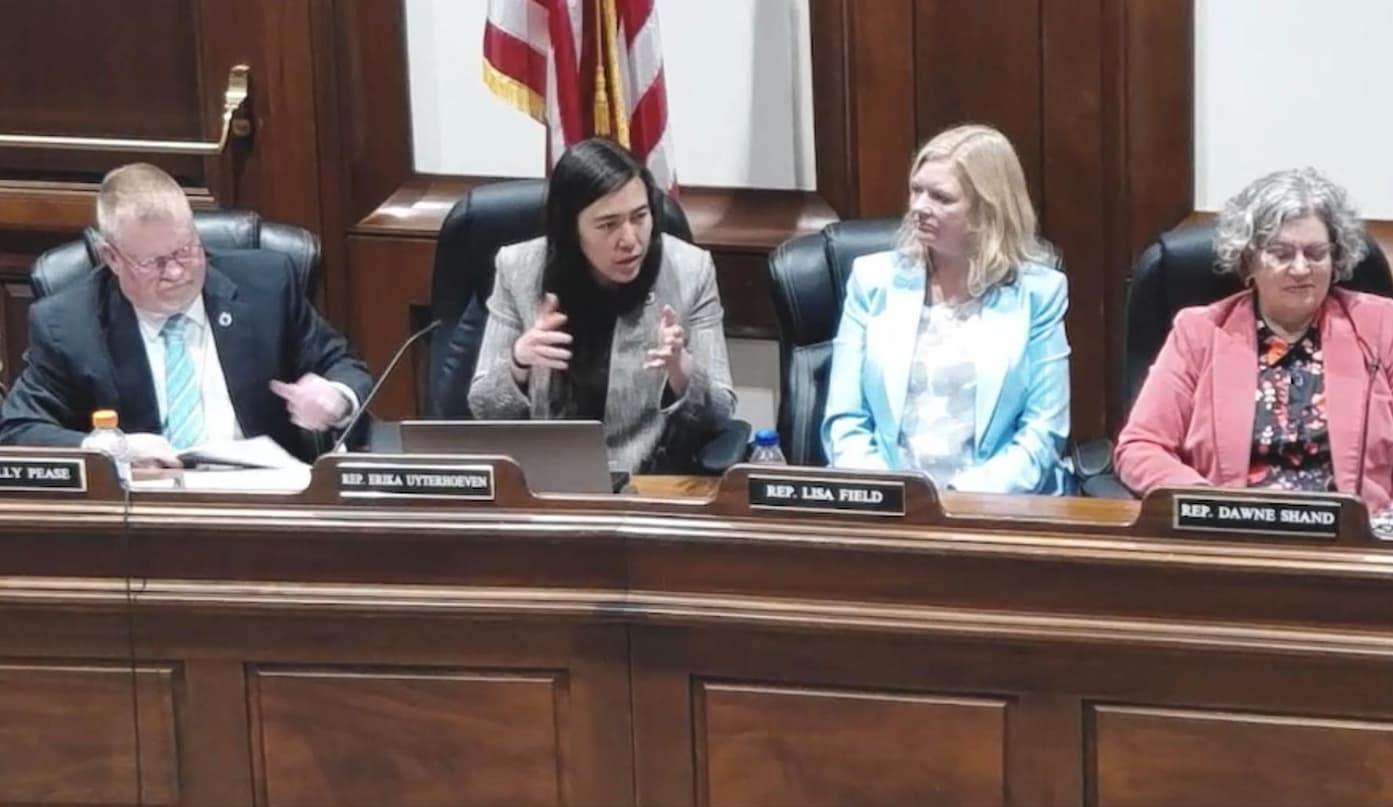
I want to break down what that actually means for our district, and then share something that has been weighing on me about the bigger picture.
What just changed?
For more than ten years, Chapter 90 was frozen at $200 million while construction costs kept climbing. Somerville residents filed more than 1,200 pothole reports through 311 last year, a 38% increase over the year before, and that is just one city in our district. This bill raises the program to $300 million, a 50% increase, with $200 million distributed through the traditional formula and $100 million based on road mileage.
For our district, that means $1.27 million for Medford (up from $955,000 under the old formula), $1.53 million for Somerville, $3.29 million for Cambridge, and $755,000 for Winchester.
Chapter 90 was stuck for over a decade, and people said it could not be increased, but the Massachusetts Municipal Association pushed, municipal leaders organized, I as your legislator made the case, and the state delivered. That is real progress.
But that only covers roads and transportation. Here is the part that has been on my mind.
What about everything that is not a road?
Chapter 90 is one form of state aid, and it covers roads and transportation. But it does not pay for your child’s educator, or the firefighter who responds when you call 911, or the librarian who keeps the doors open on weekends. That comes from a different pot called Unrestricted General Government Aid, the flexible state funding your city uses to pay for everything else, and it has not gotten anything close to the same treatment.
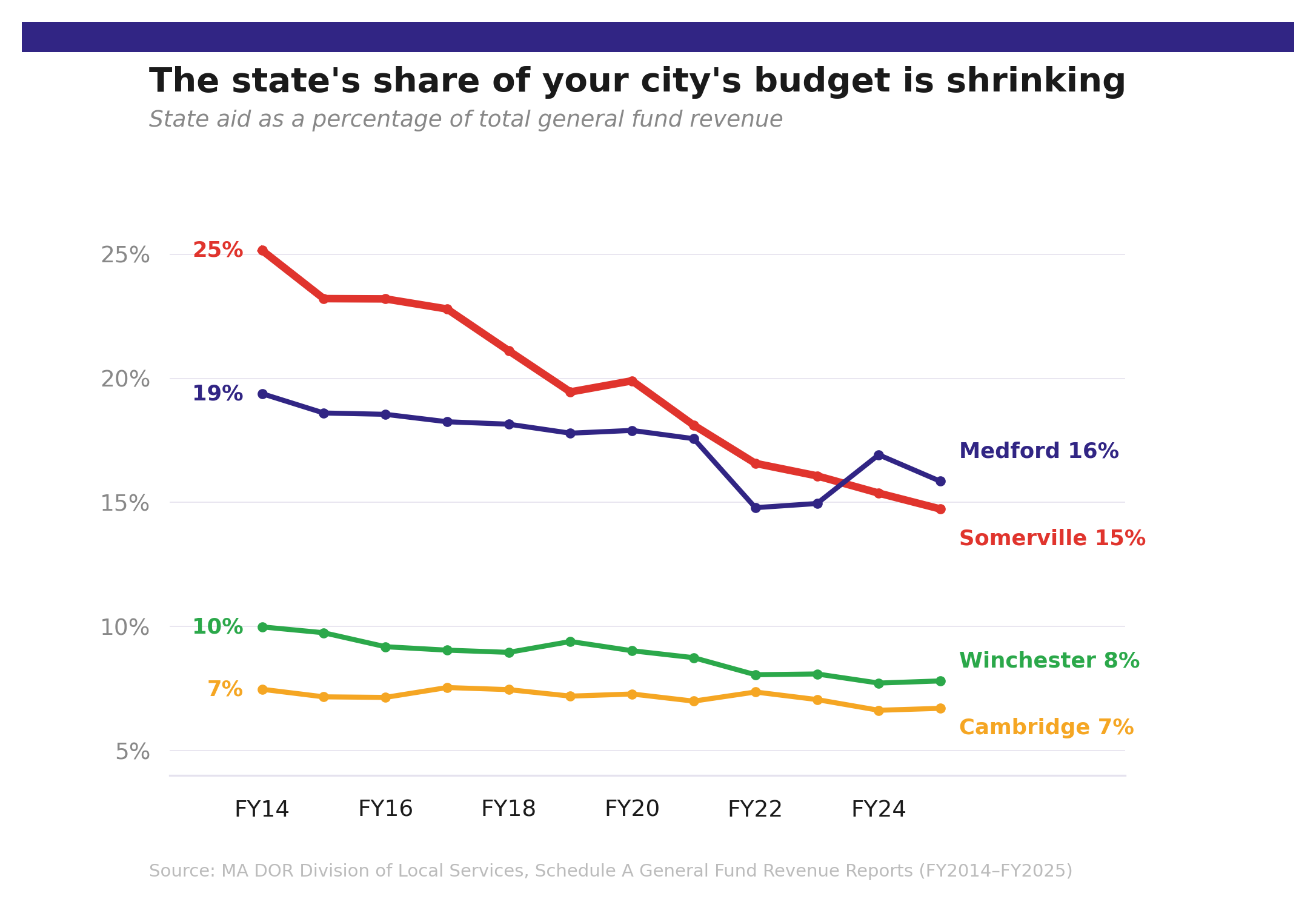
Here is what happened to your city’s funding: since 2014, the state has sent your city more dollars every year, about 44% more in total. But your city’s costs grew faster. The result: the share of your budget covered by state aid has been shrinking for over a decade, and the difference lands on your property tax bill.
|
|
25% → 15%
Somerville’s state aid share
|
|
|
19% → 16%
Medford’s state aid share
|
|
|
10% → 8%
Winchester’s state aid share
|
|
|
|
|
Source: MA DOR Division of Local Services, Schedule A General Fund Revenue Reports (FY2014–FY2025).
The state did not cut your city’s aid. It did not have to. By growing aid more slowly than your city’s costs, the state shifted more and more of the burden onto your property tax bill, and Proposition 2½ means there is a limit to how much your city can raise that way. That is why Medford needed its first override in 44 years, why Winchester’s override failed by 300 votes, and why Somerville has limited options to cover growing costs and is proposing to cut school budgets right now.
What has that meant?
In Medford, it meant the city had to ask voters for a tax increase for the first time in 44 years in order to prevent educators from losing their jobs and to begin addressing tens of millions of dollars in deferred road and sidewalk repairs.
In Somerville, it means right now. This month, the initial budget proposal is asking public schools to face a $1 million cut to account for a $5.3 million city budget deficit, something the Somerville Educators’ Union calls putting the school budget “well below level-service.”
In Winchester, an $11.5 million override (the largest ever proposed in Winchester) failed by fewer than 300 votes. Town meeting starts next week, and we are facing educator layoffs and possibly reduced library hours, and cuts to first responders.
In Cambridge, the city is bracing for the loss of $23 million in annual federal funding on top of the state aid gap, with the city manager calling it “a troubling and uncertain time.”
Four cities, one pattern. Every one of these communities has been stretching every dollar, and the gap is not local, it is structural.
|
|
Chapter 90 was stuck for a decade, and the state stepped up because people made the case with data, organized across communities, and refused to accept that level-funding was good enough. If we can do that for roads, we can do it for the aid that funds our schools, our firefighters, and our libraries.
|
|
|
Why does this give me hope?
Because when we organize and fight for what we need, we win it. We just proved that works with roads and transportation funding, and we proved it was possible when we fought and won over $1.5 billion more dollars into our public schools through the Student Opportunity Act (something the naysayers initially said could not be done).
I dug into twelve years of state financial records for every city in our district, because I believe you deserve to see what is actually happening with your money, not just hear that local aid is at “record levels” (because of inflation).
That is how I approach this work: not just showing up for the vote, but doing the work before and after. The state’s share of your city’s budget has been shrinking for over a decade, and that did not happen by accident. It happened because nobody on Beacon Hill fought hard enough to change it.
This is a problem we can fix. And I intend to be the person who fights hard enough to fix it.
|
|
What you can do: If you know someone who needs to see these numbers, please forward this to them. If your family has been affected by school cuts, reduced city services, or a property tax increase, reply and tell me your story. And follow the FY2027 budget as it moves through the House starting next Monday 4/27. I will keep you updated.
|
|
|
|
P.S. Data sources for this newsletter: MA DOR Division of Local Services Schedule A General Fund Revenue Reports (FY2014–FY2025), Cherry Sheet Trend Data, and H.5375 (the transportation bond bill).
|
|
Follow on Instagram
·
Follow on Bluesky
|
|
Yours in service,
Erika Uyterhoeven
State Representative, 27th Middlesex
Candidate, State Senate, 2nd Middlesex District
|
|
|
Facebook
·
Instagram
·
Bluesky
Paid for by Committee to Elect Erika Uyterhoeven · Somerville, MA
Contributions are not tax-deductible · $1,000 max per individual per calendar year
Unsubscribe
|
Manage Preferences
|
|